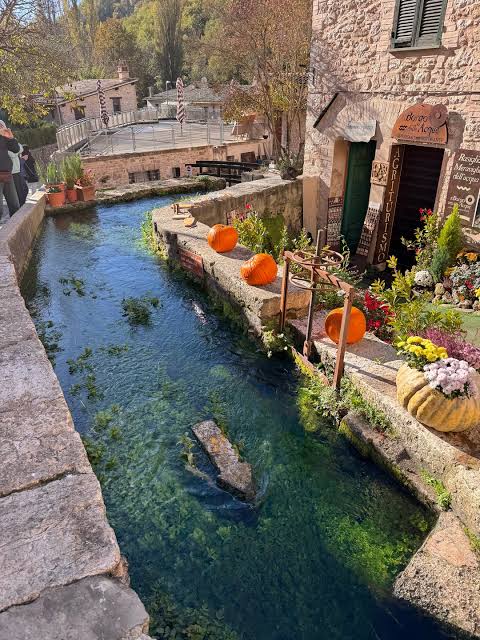
Before deciding where to point your camera in Rasiglia, try listening.
Water is the first guide. It slips alongside stone, gathers, divides and continues on its way through the village. Your eyes follow almost automatically. For once, the itinerary seems perfectly capable of organising itself.
This small Umbrian village, in the Menotre valley near Foligno, has become known for its streams and channels. The pictures are appealing. Yet the most rewarding part of a visit begins when you ask what all that water was doing here before it became something to photograph.
Beauty had a working day
The Capovena spring feeds the village’s waterways. Historically, water supported activities including milling and textile production. Rasiglia’s industrial past included wool processing, spinning and dyeing: skilled work shaped by a resource that was both nearby and powerful.
That changes the view.
A channel becomes a piece of practical intelligence. A building beside the water invites questions about the work once carried out inside. The pleasing relationship between houses and streams starts to reveal the decisions that sustained a community.
Italy is full of places described as timeless. I am usually more interested in finding the time inside them: the working hours, the seasonal changes, the years of knowledge behind an apparently simple task.
Look for the hands behind the picture
As you walk, make a little room for the village’s material history. A loom, a millstone or an account of a workshop can connect what you see to the people who used it.
You do not need to become an expert in textile production. Just imagine the sequence. Water, energy, tools, hands, a finished object. Behind the lovely setting there was effort and organisation.
This is also a useful way to visit with children. Follow a stretch of water together and ask where it is going. Then imagine designing a village around it. Where would you put a bridge? Where would you need to work? Suddenly, looking becomes a practical exercise.
And the adults may discover that their engineering proposals require revision.
A village at human scale
Rasiglia is compact. I would plan a measured visit and leave room in the wider Umbrian day for lunch or another carefully chosen stop. The aim is to arrive with enough time to notice, rather than enough obligations to hurry.
Remember that a beautiful village can also be someone’s home. Keep doorways clear, treat private spaces as private, and enjoy the channels from the paths. Courtesy is one of the simplest ways to make travel feel more human.
Before you leave, put the phone away for a minute and listen again. The water will still be doing what first caught your attention. You will simply know a little more about the life it carried.