Some buildings announce their importance before you reach the door. The Mausoleum of Galla Placidia in Ravenna is more discreet.
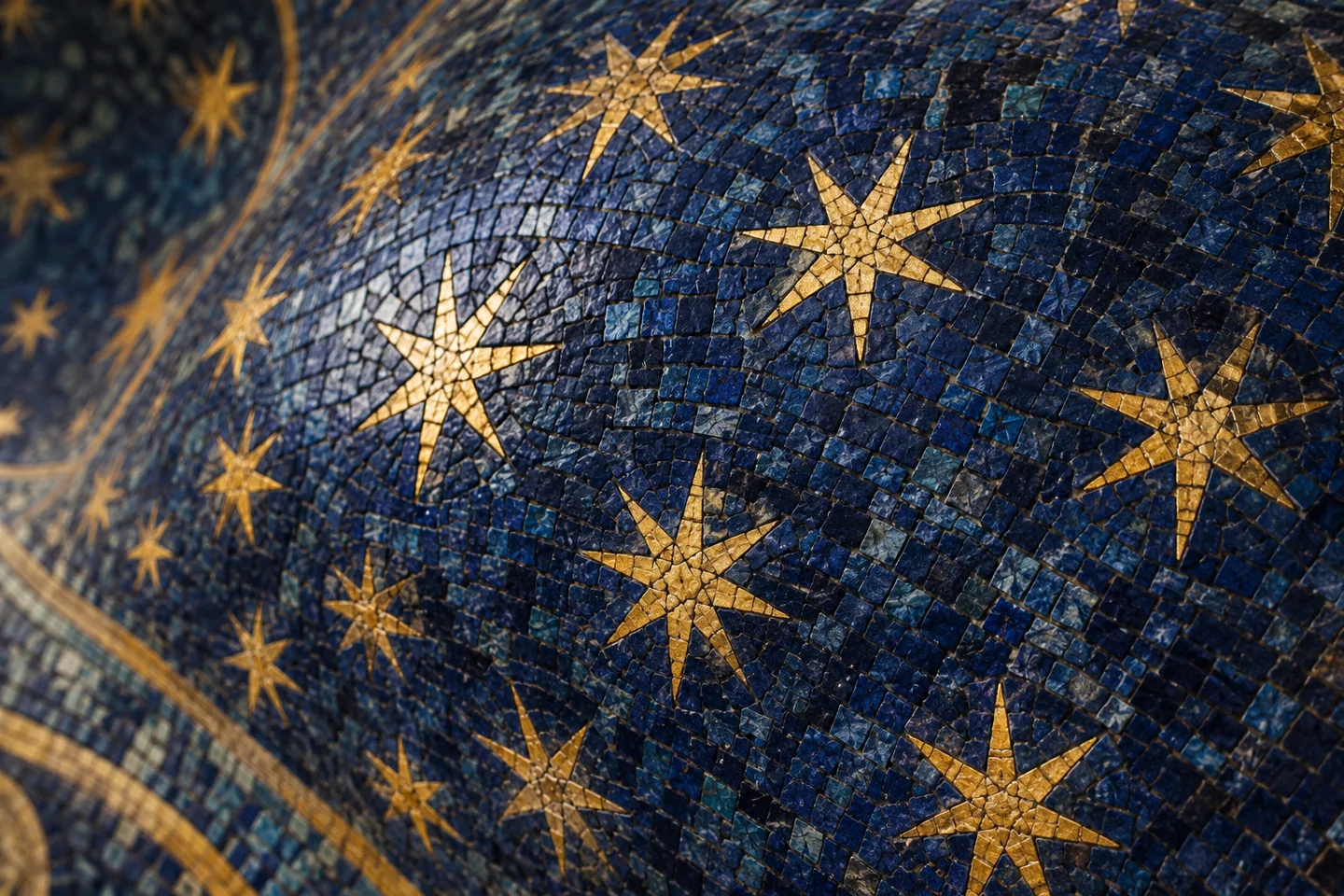
From outside, you see a small brick building. Step inside and the scale of your attention changes. Above you, golden stars gather against a deep blue mosaic sky. Suddenly, looking up feels like the most sensible thing you have done all morning.
This is a place I would approach with fewer words at first.
Give the room its first minute
The monument was commissioned in the fifth century by the empress Galla Placidia. Despite its familiar name, she was buried in Rome. It is a useful reminder that the name on a map rarely tells you the whole story.
Inside, mosaic covers the upper surfaces, drawing the eye across arches and vaults. Light, colour and the little pieces from which the images are made work together. The room feels far larger in imagination than its dimensions suggest.
Allow your eyes to adjust. Then choose a small area to study. Notice how a surface assembled from individual pieces can become a sky, an animal or a fold of cloth.
Somebody placed those pieces. An extraordinary image begins with a succession of small, deliberate decisions.
Children already know how to notice
A family visit can begin with one invitation: find something you would like to show me.
Perhaps a child chooses a star. Perhaps a sheep, a bird, a pattern. Follow that interest. Ask what drew their attention and give them time to answer before supplying your own explanation.
You can then make the conversation a little more demanding. How would you create an image if you could only use tiny pieces? Which colours would you need? What happens when you stand close to a mosaic, then look from farther away?
The point is to look together. Nobody needs to win.
Back at a table later, a few coloured scraps of paper can turn the visit into a simple creative experiment. Trying to build even a tiny picture makes the skill of the mosaic makers much easier to appreciate. It may also provide a welcome reason for everyone to sit down.
A day with room to absorb
Ravenna has a remarkable concentration of monuments. A family itinerary benefits from choosing a manageable selection and leaving pauses between them.
Check the official ticket arrangements and any booking requirements for the monuments you want to see. Within a small, carefully protected space, follow the staff’s guidance and make room for other visitors.
I would finish this encounter by asking one question outside: what colour do you remember most clearly?
There is no correct answer, although blue has a persuasive case. What matters is that everyone has carried something out of the room.
A small memory, assembled carefully, can last a very long time.